Marketing in the Age of AI: The Complete Guide for 2026

The marketing playbook that worked in 2023 is dead.
Not because the fundamentals changed, people still buy from brands they trust, content still drives discovery, and good design still converts. What changed is how fast you can execute.
In 2026, a solo marketer with AI tools outproduces a 10-person team from three years ago. The brands winning right now aren't the ones with the biggest teams or budgets. They're the ones who figured out where AI fits, and where it doesn't.
This is the guide we wish existed when we started.
What Actually Changed (And What Didn't)
Let's separate signal from noise.
What AI changed:
- Content production speed, from days to minutes
- Design turnaround, from 48-hour freelancer cycles to instant generation
- Personalization, from one-size-fits-all to segment-of-one at scale
- Data analysis, from spreadsheet marathons to real-time insights
- Distribution, from manual posting to intelligent scheduling
What AI didn't change:
- Strategy still requires human judgment. AI can't decide your positioning
- Brand voice is still built by humans. AI mimics, humans create
- Customer relationships, people still buy from people
- Creative differentiation, the most memorable campaigns still come from human insight
- Trust, 86% of consumers say authenticity matters when choosing brands (Stackla 2025)
The winners in 2026 treat AI as an execution engine, not a strategy engine.
The New Marketing Stack: What AI Replaces and What It Doesn't
Here's how modern marketing teams are restructuring their workflows:
| Marketing Function | Before AI | After AI | Human Still Needed? |
|---|---|---|---|
| Social media design | Freelancer, 2-5 days | AI generation, seconds | For brand strategy only |
| Copywriting (first drafts) | Junior copywriter, 4 hours | AI draft, 5 minutes | Yes, editing and voice |
| Email campaigns | Design + copy + test, 1 week | End-to-end generation, 1 day | For strategy and segmentation |
| Analytics reporting | Manual spreadsheets, 4 hours/week | Auto-dashboards, real-time | For insight interpretation |
| SEO content | Research + write + edit, 2-3 days | Research + AI draft + edit, 4 hours | Yes, expertise and E-E-A-T |
| Ad creative testing | 3-4 variants manually | 20+ variants generated | For performance analysis |
| Brand identity | Agency, $5K-$15K, 4-6 weeks | AI concepts + human polish, days | For strategic direction |
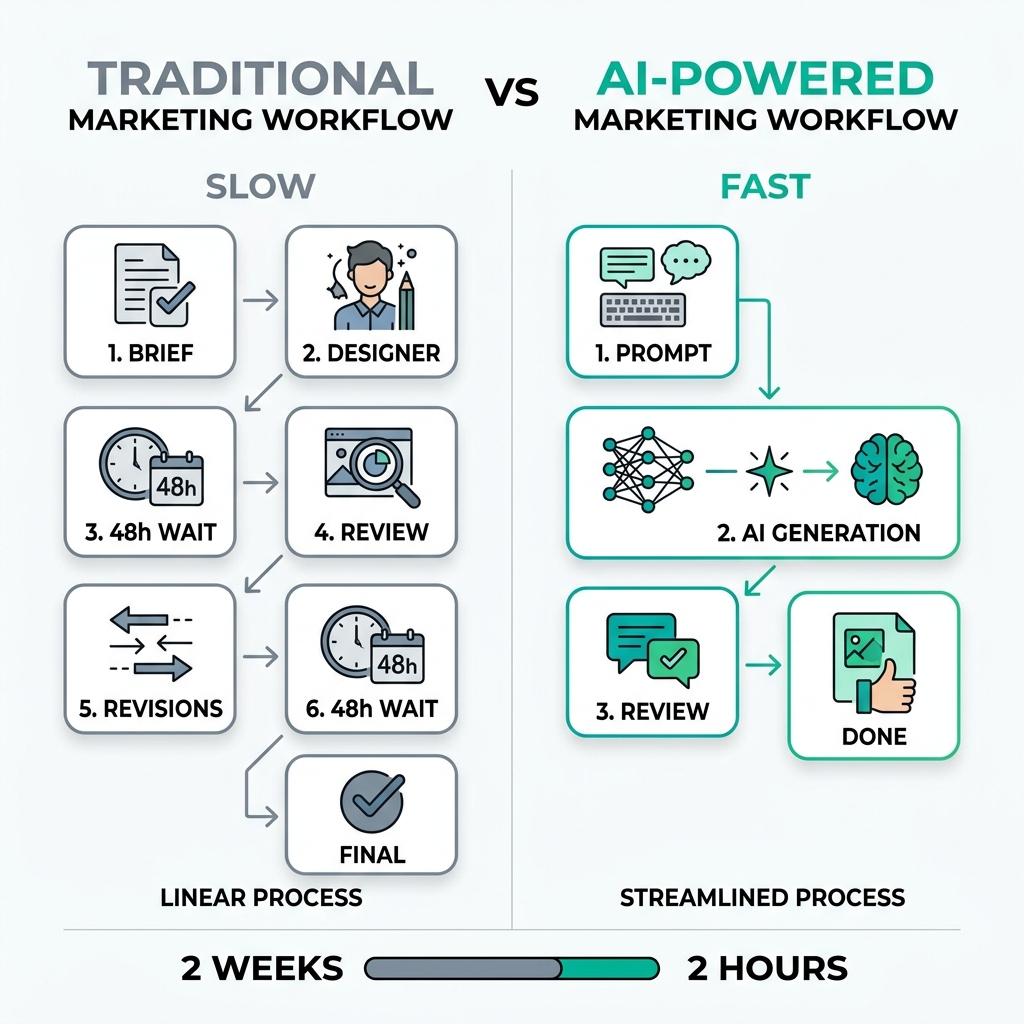
The pattern is clear: AI compresses the production layer, but the strategy layer remains human.
The 5 Pillars of AI-Era Marketing
Pillar 1: Speed as a Competitive Advantage
In traditional marketing, speed was a luxury. Now it's table stakes.
The math that changed everything:
A typical small business needs ~30 pieces of marketing content per month:
- 20 social media posts
- 4 email campaigns
- 2 blog articles
- 4 ad creatives
Old way: 1 designer + 1 copywriter + 1 marketer = $8,000-$15,000/month in labor New way: 1 marketer with AI tools = $200-$500/month in subscriptions
That's not a marginal improvement. It's a structural shift that lets bootstrapped startups compete with funded competitors on content volume.
Real example: A coffee shop owner can now generate a week's worth of Instagram posts, complete with on-brand graphics, captions, and hashtags, in 15 minutes on a Monday morning. Three years ago, that same output required a $2,000/month social media agency retainer.
Pillar 2: Brand Consistency at Scale
The biggest risk of AI-powered marketing isn't low quality, it's inconsistent quality. When you're producing 10x more content, brand drift becomes your real enemy.
The solution: Brand profiles as infrastructure.
Modern AI design platforms let you define your brand once, logo, colors, fonts, tone of voice, photography style, and every piece of content generated after follows those rules automatically.
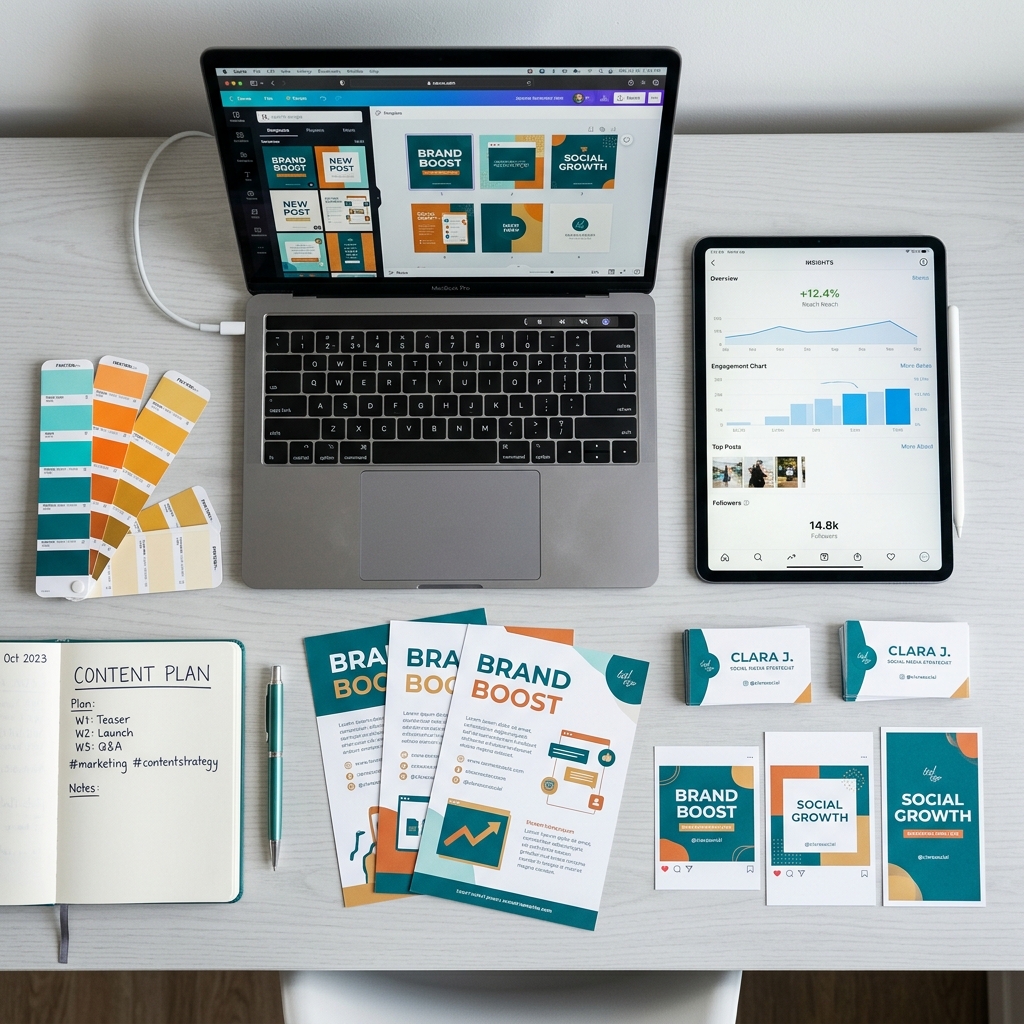
This is actually an improvement over the old way. When you hired different freelancers for different projects, brand consistency depended on how well they read your brand guidelines PDF (spoiler: most didn't read it thoroughly).
With AI, brand rules are programmatic. Colors don't drift. Fonts don't change. Logo placement is always correct.
Pillar 3: The "1 Prompt, 5 Platforms" Workflow
The biggest time sink in social media marketing isn't creation, it's adaptation. You design one Instagram post, then manually resize it for Facebook, LinkedIn, Twitter, TikTok, and Stories.
AI-era workflow:
- Write one brief: "Summer sale announcement, 20% off all drinks this weekend"
- Generate one concept in your brand style
- Auto-adapt to every platform ratio:
- Instagram Feed (1:1)
- Instagram Story (9:16)
- LinkedIn Post (1.91:1)
- Facebook Cover (16:9)
- TikTok Cover (9:16)
Time saved per content piece: ~45 minutes, which compounds to 22+ hours per month if you're posting daily.
Tools like Meepo handle this natively, describe what you want, select the platforms, and the AI generates format-optimized versions automatically. Brand colors, fonts, and logo placement stay consistent across all outputs.
Pillar 4: Campaign Thinking, Not Post Thinking
Amateur marketers think in individual posts. Professionals think in campaigns.
Campaign-level AI generation is the biggest unlock most teams haven't discovered yet. Instead of creating content one piece at a time, you describe an entire campaign and let AI generate a cohesive content series:
"Ramadan campaign for our restaurant. 2 weeks. Include: teaser countdown, iftar menu promotions, family package deals, customer testimonial highlights, and Eid greeting."
Result: 15-20 interconnected design concepts that tell a story across 2 weeks, visually consistent, thematically connected, with variety in format (single images, carousels, Stories).
What used to take a marketing agency 2-3 weeks and $3,000-$5,000 now takes 15 minutes.
Pillar 5: Human Polish on What Matters
Not all content deserves the same level of attention. The AI-era insight is knowing when to ship AI output directly and when to add human polish.
Ship AI directly (80% of content):
- Daily social media posts
- Internal communications
- Quick promotional graphics
- Story content (24-hour lifespan)
- Email header graphics
- A/B test ad variants
Add human polish (20% of content):
- Brand launch campaigns
- Investor presentations
- Hero website graphics
- Print materials
- Video ads for paid campaigns
- Annual report design
This 80/20 split is how modern teams achieve agency-quality output without agency-level budgets.
On platforms like Meepo, this maps directly to plan tiers, use AI-only plans ($8-$20/month) for daily content, and agency plans ($199-$699/month) when you need human designers to polish high-stakes materials.
The Marketing AI Stack: What Tools You Actually Need
Here's the minimal viable marketing stack for 2026, and what each layer does:
Layer 1: Content Strategy (Human-Led)
- Google Trends / SparkToro, audience research
- Notion / Linear, content calendar planning
- Your brain, positioning, differentiation, creative direction
Layer 2: Content Production (AI-Powered)
- Design generation. AI design platforms (Meepo, Canva, Adobe Express)
- Copywriting. LLMs for first drafts (Claude, ChatGPT, Gemini)
- Video. AI video generators for short-form content
- Photography. AI image generation for concepts, stock for final
Layer 3: Distribution (Automated)
- Meta Business Suite / Buffer / Hootsuite, scheduling
- Mailchimp / Resend, email automation
- Auto-posting from design platforms directly to social channels
Layer 4: Analysis (AI-Assisted)
- Google Analytics 4, traffic and conversion
- Platform native analytics, engagement metrics
- AI-powered reporting, automated insight summaries
Key principle: The strategy layer (Layer 1) and the analysis layer (Layer 4) remain human-intensive. The production layer (Layer 2) and distribution layer (Layer 3) are where AI creates the most leverage.
Common Mistakes in AI Marketing (And How to Avoid Them)
Mistake 1: Publishing AI Output Without Review
AI generates, humans curate. Every piece of content should pass through a 30-second human review before publishing. Check for:
- Factual accuracy
- Brand voice alignment
- Cultural sensitivity
- Visual quality
Mistake 2: Using AI for Everything
AI can't replace genuine expertise. If you're a fitness coach, your personal workout videos will always outperform AI-generated fitness tips. Use AI for the production tasks (designing the thumbnail, creating the social graphic, writing the caption structure) while keeping the expertise authentically human.
Mistake 3: Ignoring Brand Guidelines
"Just generate something" leads to visual chaos. Invest 10 minutes setting up a proper brand profile in your AI design tool before generating anything. Your future self will thank you.
Mistake 4: Quantity Over Quality Spiral
AI makes it easy to produce 100 pieces of content per month. But 100 mediocre posts perform worse than 30 great ones. Use AI speed to iterate on quality, not just volume.
Mistake 5: Forgetting the Human Touch
The best-performing content in 2026 is still the content that feels personal. Use AI for production, but inject human stories, behind-the-scenes moments, and authentic personality. AI generates the design, you provide the soul.
How to Start: The 7-Day AI Marketing Sprint
If you're transitioning from traditional marketing to an AI-powered workflow, here's a practical 7-day plan:
Day 1: Audit and Plan
- List all content you produce monthly
- Identify which pieces can be AI-generated vs. human-created
- Set up your brand profile in an AI design tool
Day 2: Social Media Batch
- Generate an entire week of social media posts in one sitting
- Test different styles and formats
- Select the best concepts
Day 3: Email Campaign
- Use AI for email copy drafts and header graphics
- Set up one automated email sequence
Day 4: Content Adaptation
- Take your best-performing content
- Adapt it across all platforms using AI format adaptation
- Schedule everything
Day 5: Campaign Test
- Run one campaign-level generation (e.g., "Weekend Sale Campaign")
- Review the cohesion and quality of the output
Day 6: Optimize
- Review engagement data from Days 2-4
- Identify what performed best
- Double down on winning formats
Day 7: Systematize
- Create your weekly content production routine
- Set a recurring 30-minute block for batch content generation
- Document your brand prompts that produce the best results
The Bottom Line
Marketing in the AI era isn't about replacing humans with machines. It's about freeing humans from production bottlenecks so they can focus on what actually drives growth: strategy, creativity, and authentic connection.
The brands that win in 2026 and beyond will be the ones who master the balance, using AI to execute at 10x speed while keeping human judgment at the center of every important decision.
The tools exist. The playbook is here. The only question is how quickly you adapt.
Ready to automate your marketing design workflow? Try Meepo free. AI generates professional, brand-consistent content in seconds. 20 free credits, no credit card required.
Ready to automate your design workflow?
Try Mosea free. AI generates designs instantly, human designers polish to agency quality.
Start Free